
Orchards designed for the future
Science has been a major driver of productivity gains in New Zealand’s apple industry. In the 1960s, apple orchards produced an estimated 22 tonnes of fruit per hectare. Today, New Zealand is recognised as one of the world’s most efficient apple producing countries, with average yields sitting at around 54 tonnes per hectare over the past decade.
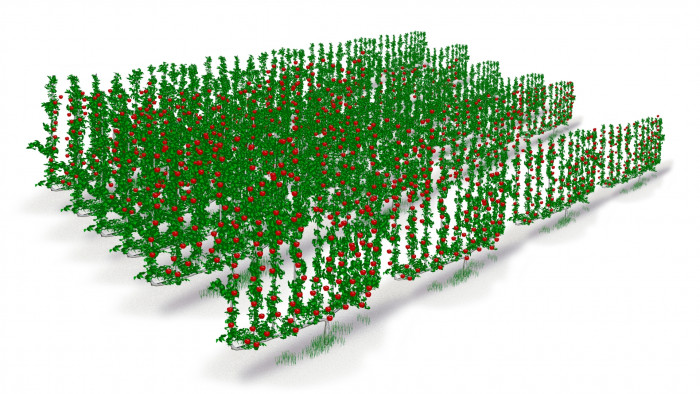
The Future Orchard Planting System (FOPS)
In the 1970s New Zealand orchards started to look a little different to those around the world, with smaller but more densely planted trees trained to grow in ways that produced more fruit and were easier to maintain. Horticultural science has continued to advance in recent decades, and soon New Zealand’s orchards could support robotic harvesting and be managed with the help of digital twin technology.
By the 1980s scientists were working to understand how orchard canopies capture light and drilling further into what influenced fruit yield and quality. This foundational research helped inform the development of a new planting system, which was initiated within a programme that started in 2013, entitled, the Future Orchard Planting System (FOPS). This new system, a narrow row, planar cordon system, doubled yields and improved fruit quality by bringing orchard rows closer together and growing trees in a planar (two-dimensional) structure in research trials. In some trials, yields of more than 230 tonnes per hectare have been documented.
This system has since been established in early adopter grower blocks, with similar yield and fruit quality benefits starting to be demonstrated. It is better suited to automation and robotics than conventional orchards, as fruit is more visible and accessible.
In the future, orchard management could also be informed by new technologies such as digital twinning. Scientists are working on an innovative project creating a virtual replica of a real orchard, combining orchard ecosystem modelling, data science, advanced sensing technologies, machine learning, computer vision and field work. The digital twin is designed to predict how an orchard will respond to different scenarios, such as changes in management or climactic conditions in orchards.