
Frozen assets
New Zealand’s presence in Antarctica is a vital expression of our role as one of the original Antarctic Treaty partners, and our nearly 70-year continuous occupation at Scott Base stands as a remarkable national achievement.
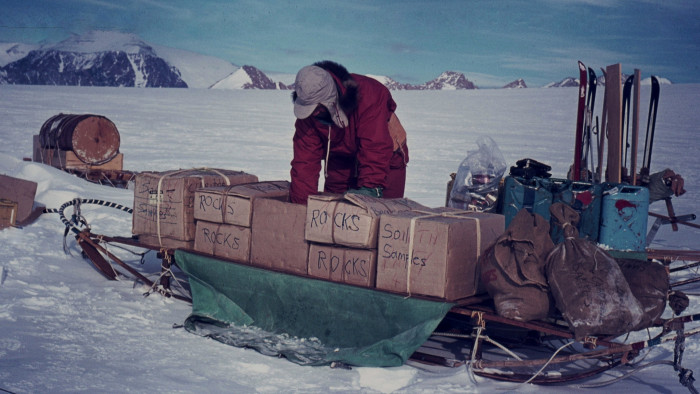
Graeme Claridge packing accumulated soil samples, 1969. Image: Iain Campbell
Since 1957, the base has enabled an unbroken record of weather observations, supported thousands of scientific missions, and strengthened New Zealand’s longstanding collaborations with other national Antarctic programmes. Keeping Scott Base operating is essential to sustaining this influence and fulfilling our responsibilities on the continent.
Soil science in Antarctica also began in 1957, when scientists on the initial Commonwealth Trans-Antarctic Expedition filled a biscuit tin with soil from where the Scott Base huts were under construction. Over the years, scientists have brought back 8,837 soil samples, topping the scales at more than 1.5 tonnes and now stored at the National Soil Archive. Pristine Antarctic soils from the 1950s are time capsules free of contaminants such as microplastics, and a valuable baseline against which subsequent environmental and climate changes can be measured.
Ecologists have recently helped to identify areas of ecological significance in Antarctic waters, using telemetry attached to the backs of breeding adult Adélie penguins to track their seasonal movements around the Ross Sea. Adélie are a sentinel species because changes in their behaviour or populations indicate changes in climate (which can be seen in the ice) or the fisheries they depend on. This science will help inform future protection of the unique habitats and ecosystems of this part of the Southern Ocean – designated as the world’s largest Marine Protected Area in 2017.