Speed matters
Computing speed is fundamental to the exploration of possibilities by science. Earth Sciences New Zealand and its predecessor NIWA, have been investing in supercomputers to facilitate faster computing since 1999, upgrading them about every seven years.
In 2025 the organisation installed its fourth supercomputer iteration – a $35 million investment named Cascade that has a companion data archive known as Rapids. They were installed at CDC data centres in Auckland.
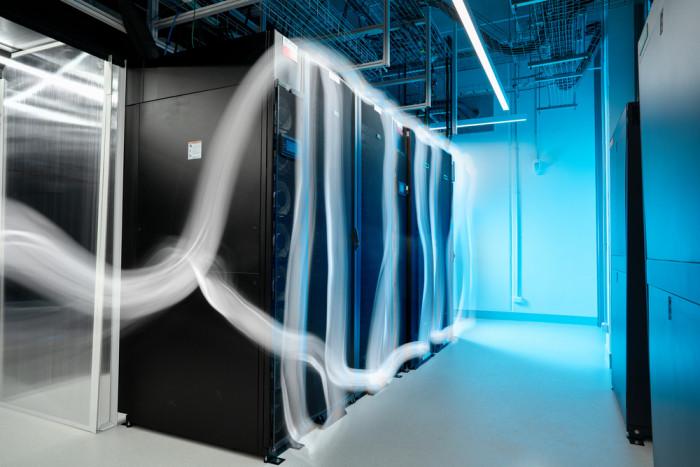
This Auckland-based supercomputer is capable of incredible speed, allowing for complex AI modelling. Photo: Earth Sciences NZ
This upgrade is three times more powerful than its predecessor, capable of computing speeds of 2.4 petaflops, allowing for higher resolution, more frequent processing and the use of additional AI workloads all while running entirely on renewable electricity.
One of its key uses is the provision of more accurate, timely and impact-focused weather forecasts.
It also supports simulations of oceanographic systems, freshwater dynamics, and seismic activity – assisting scientists to model natural hazards, including floods, earthquakes, and droughts.
Cascade can also assess climate change impact, helping us understand our weather under long-term environmental shifts. The level of detail it produces is crucial and will mean better planning for protection of people and infrastructure as the climate changes.
And Cascade has already expanded with the recent deployment of new B200 NVIDIA GPUs producing weather AI training runs that previously took weeks in less than a day.
As supercomputing technology develops, so too does the scope of the questions scientists are able to ask it to tackle. A data-driven approach means the sky may not be the limit in another seven years.