
Science supporting effective fisheries management
Fisheries research is vital to for sustainable fisheries and protection of the marine environment.
Carrying out surveys, stock assessments and other research informs fisheries managers in government (Fisheries New Zealand). Scientists work to understand current fish stocks and to predict the effects of different management decisions. These programmes involve monitoring fish stock biomass, size and age composition to enable better prediction of changes in fish abundance.
Stock monitoring and assessment methods are robust, standardised where appropriate, and continually upgraded as new or improved methodologies or technologies become available.
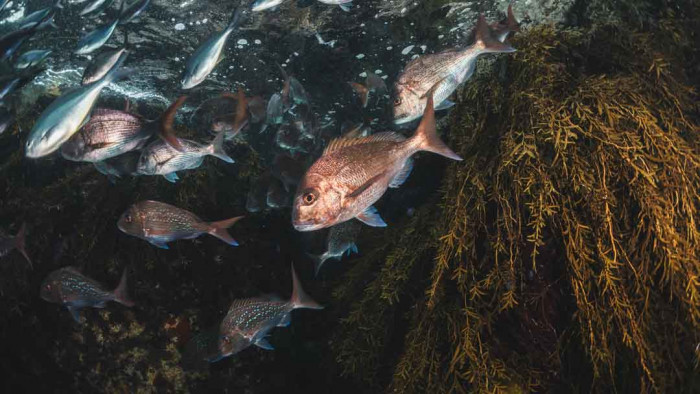
Scientists determine the health of our fisheries via surveys, stock assessments and monitoring programmes. Photo: Irene Middleton
A key part of this work is carried out on scientific research vessels. Survey data collected from the deepwater vessel RV Tangaroa and the inshore vessel RV Kaharoa form the basis of a 30-plus year time series to monitor a range of important species, such as hoki, hake, ling, snapper, tarakihi, red gurnard and john dory. RV Kaharoa II, a new vessel, continues the work of its predecessor in monitoring the abundance and distribution of New Zealand inshore fish. Its increased capability will enhance that work.
New Zealand has developed open-source software for fisheries stock assessment (CASAL/Casal2) and for acoustic data processing (ESP3) that are used by academic and research institutes internationally. Custom deep-towed echosounder systems enable estimation of species such as orange roughy in waters deeper than 1000 metres. Also measured is the impact of fishing on the environment and the influence of the environment on fish and fisheries.