
Science building capability in the Pacific
New Zealand scientists have supported government ministries and research stations of Pacific Island countries with climate-resilient agriculture and sustainable land-use information since the early 20th century, when work began on the Pacific Island Plant archive.
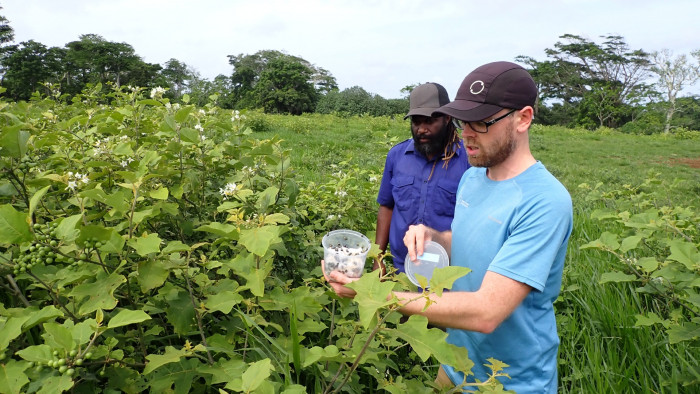
Arnaud Cartier (right) working with the Vanuatu Biosecurity team to release pico beetles in Vanuatu.
During that time, this research has helped to build capability on the ground in soil science, weed biocontrol, indigenous flora, seed banking and genotyping, climate-resilient crops and food security, as well as producing an online portal of detailed soil maps. Soil surveying of Fiji, for example, began in 1956 with the first national soil resource assessment, and continued until 1988. Scientists have since became involved in soil chemistry and nutrient analyses, field trials and food crop monitoring using computer modelling.
We are currently the technical lead for the Natural Enemies - Natural Solutions Programme (NENS) which, as part of the Pacific Regional Invasive Species Management Support Service (PRISMSS), delivers weed biocontrol agents to tackle invasive weeds across the Pacific.
As part of NENS, in 2023 we mapped African tulip tree (Spathodea campanulata) and falcataria (Falcataria moluccana) across Rarotonga. The African tulip tree is a large, destructive, invasive tree that is widespread throughout the Pacific region and considered one of the 100 worst invasive species in the world.
We showed that there are approximately 22,000 tulip trees and 12,000 falcataria trees on Rarotonga – covering nearly 7% of the entire island. Locals were shocked at the extent of the invasion. They knew that the weed invasion was happening, but seeing the map really highlighted the true extent of the distribution and spread. A gall-forming mite (Colomerus spathodeae) and leaf-mining flea beetle (Paradibolia coerulea) have recently been released onto Rarotonga by our weed biocontrol team to help control the African tulip tree, and we will continue to measure their impacts over the coming years.
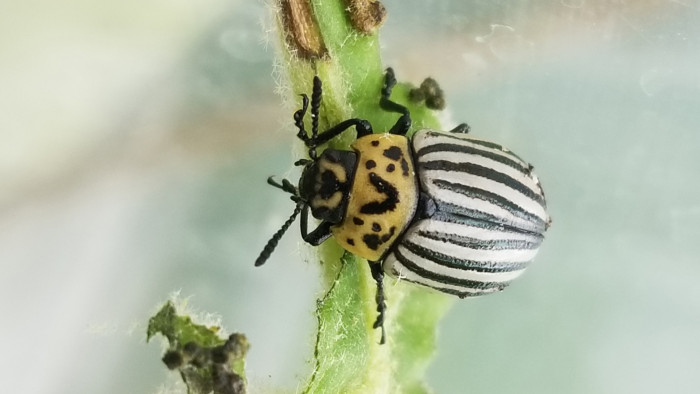
Close-up of the Pico beetle, Leptinotarsa undecimlineata