Rapid, reliable and resilient
Aotearoa New Zealand deployed a DART (Deep-ocean Assessment and Reporting of Tsunami) tsunami monitoring network in 2019. The deployment was driven by the discovery of “stealth tsunamis”, which are tsunamis that are caused by earthquakes that aren’t strongly felt in New Zealand, but could arrive within an hour, as well as the need to deliver actionable tsunami forecasts.
The DART network significantly improves the accuracy and speed of warnings by rapidly confirming what is a real tsunami and what isn’t. This is an essential safeguard in a region where destructive waves can arrive in under an hour.
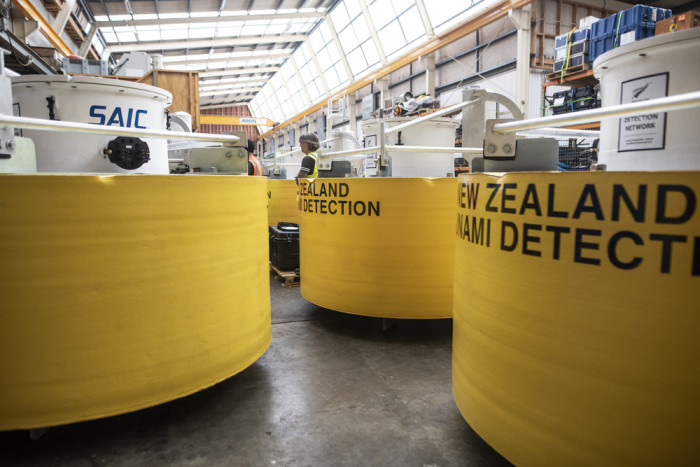
The network provides rapid, reliable detection of tsunami waves across the Southwest Pacific, including stealth tsunamis from our region of the world. 12 strategically placed stations near major tsunami-generating earthquake zones, including the Hikurangi, Kermadec, Tonga, and South New Hebrides trenches, were chosen by Earth Sciences NZ and the National Emergency Management Agency (NEMA) to maximise early‑warning capability for both regional and distant tsunami threats, helping to protect New Zealand and our Pacific partners.
Each DART station includes a bottom pressure recorder on the seafloor and a surface buoy. The recorder measures minute changes in water pressure (less than a millimetre) caused by passing tsunami waves. These measurements are sent acoustically to the buoy, then relayed via satellite to the 24/7 National Geohazards Monitoring Centre (NGMC) at Earth Sciences NZ in Wellington. Analysts and automated modelling systems verify whether a tsunami has been generated and estimate its size, arrival time, and potential impact.
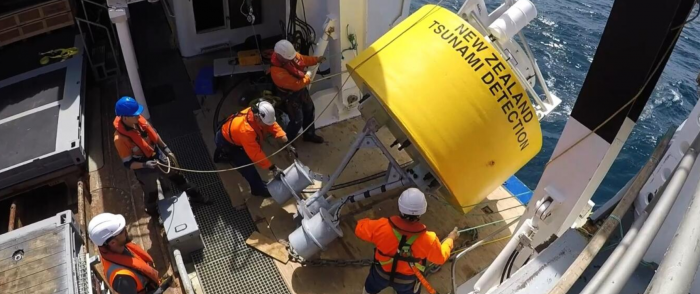
A DART buoy is launched into the Pacific to monitor tsunami. Photo: Earth Sciences NZ
If a threat is confirmed, the NGMC alerts the 24/7 Monitoring, Alerting and Reporting Centre at NEMA, which issues public warnings, including Emergency Mobile Alerts. The network also provides data to the national Tsunami Experts Panel and the Pacific Tsunami Warning Center.
Following the 2025 M8.8 Kamchatka earthquake, Earth Sciences NZ’s RCET programme used DART data to provide New Zealand’s first time-dependent forecast of the evolution of the threat prior to the tsunami’s first arrivals on our shores. The network has also been used by the United Nations to underpin tsunami early warning procedures for the whole Pacific following the 2022 Hunga Tonga volcanic eruption and tsunami.