
From Rutherford to today
Inside a turret-like tower on Wainuiomata hill, a 3.7‑metre machine of steel and voltage hums with an incredible presence. It New Zealand’s only ion beam accelerator facility, and it produces beams of charged atoms (ions) accelerated by up to 3 million volts. Both scalpel and sledgehammer, it allows scientists to understand, and alter, the physical world at the atomic scale.
Its story traces back to Ernest Rutherford and his student Ernst Marsden, who helped shape New Zealand’s scientific research system. Marsden became DSIR’s first director in 1926 and established a team of scientists to carry out research into atomic energy. This team then moved to the Institute of Nuclear Sciences at Gracefield in 1959, where the accelerator was commissioned in 1966.
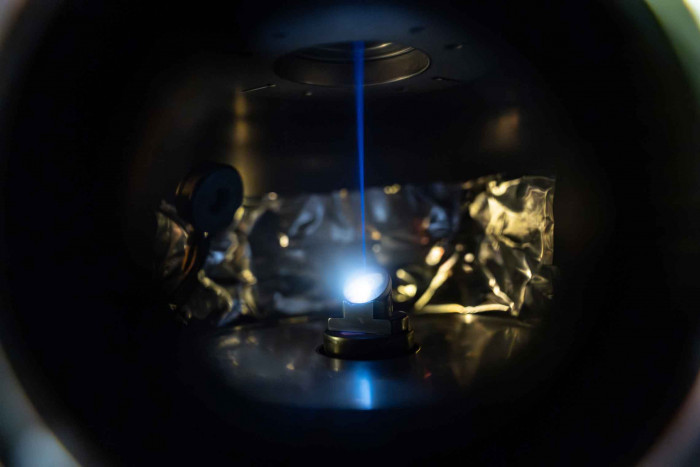
New Zealand’s only particle accelerator enables scientists to understand, and alter, the physical world at the atomic scale. Photo: Earth Sciences NZ
Inside the accelerator, a moving belt builds up electrical charge, creating an electric field that pulls ions into a tightly controlled beam. When the beam strikes a sample, detectors reveal the sample’s elemental composition and atomic structure. Over decades, this capability has supported national environmental monitoring by tracing pollutants in New Zealand’s air.
Over six decades, scientists have continuously upgraded the accelerator. In 2002, the team installed low-energy ion implanters that precisely place ions beneath a surface, helping improve materials used in telecommunications and electronic devices.
Today, researchers at Earth Sciences New Zealand are using the accelerator to develop semiconductor, quantum, and thermoelectric materials. Most recently, the team are improving green hydrogen and ammonia technologies to help New Zealand secure a sustainable and sovereign energy source.
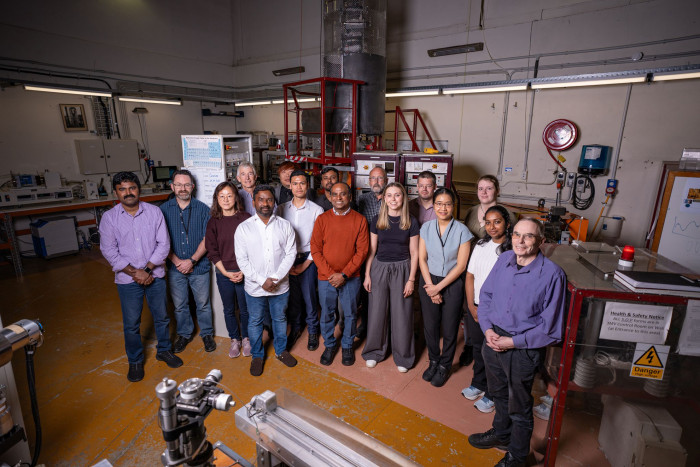
The materials team at Earth Sciences NZ in front of the beam.