
Longest record of pH measurements
In recent years the impacts of ocean acidification have attracted increasing scientific attention. Scientists are particularly concerned about the survival of organisms that have shells composed of carbonate, as it becomes more difficult to grow and maintain these in a more acidic ocean. This may affect a diverse range of organisms including corals, phytoplankton and zooplankton, algae and molluscs including shellfish.
Named after the research vessel it all started on, the Munida Time Series is the longest-running record of pH measurements in the Southern Hemisphere and is recognised globally as a foundational study tracking ocean uptake of CO2 over decades. The series has proved invaluable because it covers the coastal, subtropical and subantarctic water currents in a one-day trip: one of the few places in the world where this is possible.
Starting in 1998, a vessel has left Otago harbour every two months to collect water samples along a 65-kilometre line that extends into offshore sub-Antarctic waters. Careful measurements of CO2 and pH have been made to track how these vary seasonally, from year to year, and also over the long- term.
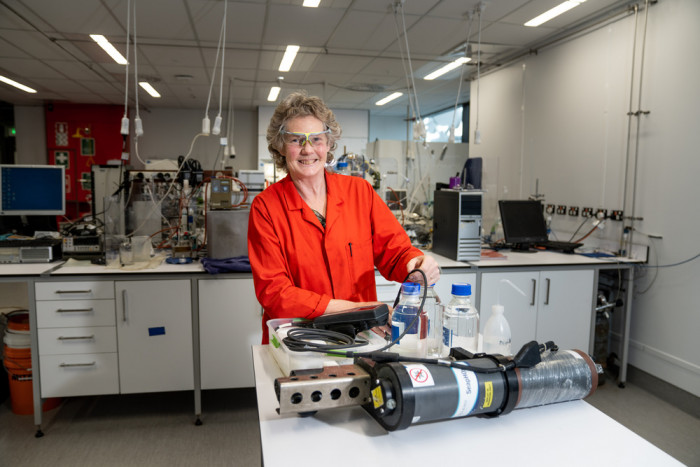
Kim Currie, co-founded the Munida Time Series which has regularly measured ocean acidification for more than 25 years. Photo: Earth Sciences NZ
It exists through a strong partnership between scientists at Earth Sciences NZ and University of Otago – Ōtākou Whakaihu Waka. The series owes its existence to countless people, including Kim Currie, Keith Hunter and Malcolm Reid.
The application of this dataset is vital. For example, the time series has established that waters around the South Island are acidifying at a rate consistent with the build-up of CO2 in the atmosphere. Furthermore, a recent study published in AGU Advances by Sebastiaan van de Velde van de Velde, who now coordinates the time series, found that calcium carbonate buffering is occurring in shallow shelf waters. This knowledge is important because it identifies natural processes that may suppress acidification and increase CO2 uptake, and also informs proposed efforts to combat climate change by deliberately increasing ocean alkalinity.