
New Zealand apples on the world stage
In your fruit bowl, you're likely to have an apple that was bred on a research orchard in New Zealand. From Royal Gala, which was launched in the 1960s, to JAZZ™ and ENVY™ branded apples in the 2000s, to recently commercialised varieties like the pink-fleshed FIZZ™ branded apple, New Zealand apples are enjoyed around the world.
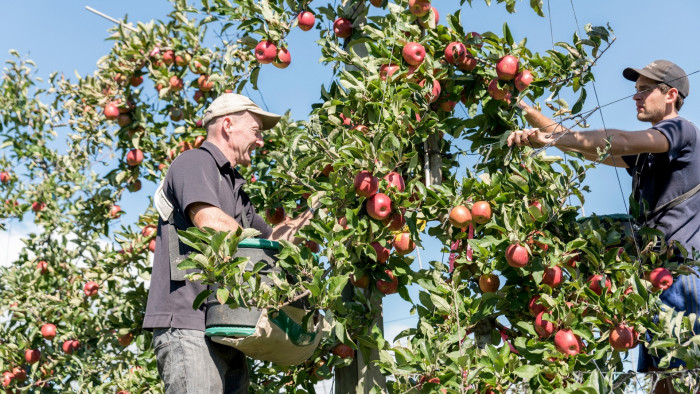
Scilate’ (ENVY™) apples at the Bioeconomy Science Institute's Hawke's Bay research orchard.
In 1985, while more traditional apple varieties were performing well as export crops for New Zealand growers, the industry knew it couldn’t stand still. International competitors were starting to grow similar varieties – and with higher production and shipping costs, local growers needed a competitive edge. The only way to stay ahead was through innovation and discipline, developing new cultivars.
Key cultivars to emerge from this focused effort included ‘Sciearly’ (Pacific Beauty®), ‘Scired’ (Pacific Queen®), ‘Sciros’ (Pacific Rose®), ‘Scifresh’ (JAZZ™) and ‘Scilate’ (ENVY™). Together, these varieties have helped shape New Zealand’s apple industry, setting new benchmarks for flavour, texture and quality. JAZZ™ and ENVY™ apples, marketed by T&G Global, are today enjoyed by consumers in more than 50 countries, with ENVY™ recently surpassing 1 billion dollars in global sales.
The next generation of apples continues to emerge from the breeding pipeline commercialised by innovation company Prevar. These include varieties marketed as Dazzle™, JOLI™, the award‑winning Sassy™, the world’s first miniature apple Rockit™, and GoodnessMe®, the first cultivar to feature double‑gene resistance to apple scab.
Scientists are focused on breeding apples that perform well in premium markets, have traits such as improved disease resistance, and are resilient to future challenges. Apple cultivar ‘HOT84A1’ – marketed as TUTTI™, was launched in 2023 and is a landmark achievement for New Zealand scientists alongside their Hot Climate Partnership partners (IRTA, Fruit Futur, and VentureFruit), recognised as the world’s first apple bred specifically for warm climates.