
It’s all up in the air
Understanding how Earth’s atmosphere is changing requires long-term measurements taken in places where global signals are clearly visible.
For New Zealand, two strategically important sites for this work are Lauder in Central Otago and Arrival Heights near Scott Base in Antarctica. Atmospheric research at Lauder started in the 1960s, making it one of the longest-running atmospheric monitoring sites in the Southern Hemisphere. Its clear skies, dry climate, and distance from major pollution sources make it ideal for measuring ozone, greenhouse gases, and ultraviolet (UV) radiation. Arrival Heights extends this work into Antarctica, offering a valuable polar perspective on atmospheric processes.
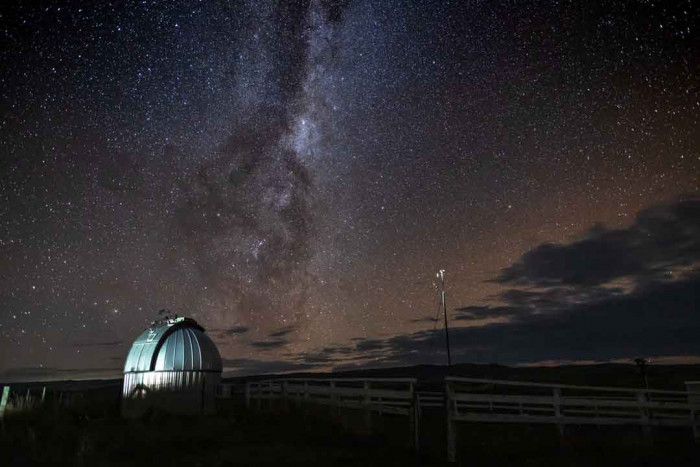
Lauder Dobson Spectrophotometer dome under the Milky Way. Photo: Jill Scott / ESNZ
A significant milestone occurred in 1999, when measurements from Lauder and Arrival Heights showed the first clear, long-term evidence that harmful UV radiation was increasing due to ozone depletion. This finding improved global awareness of risks to human health and ecosystems and encouraged international action under the Montreal Protocol.
Data from Lauder and Arrival Heights contribute to global observing networks that support modern atmospheric science, including the Total Carbon Column Observing Network (TCCON) and the Reference Upper Air Network (GRUAN). These networks help calibrate satellites, improve weather and climate models, and ensure that measurements from around the world can be reliably compared.
Today, research at Lauder and Arrival Heights continues to develop, supporting greenhouse gas monitoring and international climate modelling partnerships. Together, they provide critical evidence of how the atmosphere is changing and help shape the science needed for future planning.