Rewriting the language of plant disease names
Collections of microorganisms help us understand what’s present in the New Zealand environment already, identify what’s new and sometimes hold the answers to global problems.
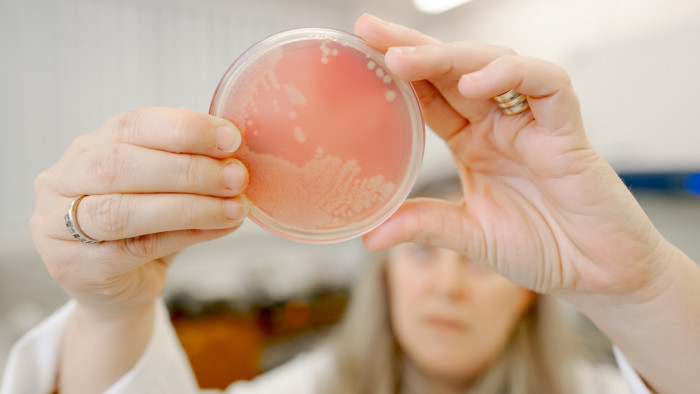
Examining a sample in the ICMP (International Collection of Microorganisms from Plants)
The International Collection of Microorganisms from Plants (ICMP) didn’t just preserve microbes, it helped rewrite the global language of plant disease. In the late 1970s, plant pathogenic bacteria were in taxonomic disarray. Many had been named as separate species based solely on the plants they infected, with little genetic or phenotypic evidence to distinguish them. Then came the 1980 international “reset.” Under new rules, any bacterial name not linked to a well-characterised living culture was discarded. Scientifically necessary, but potentially disastrous for plant pathology.
Without a solution, dozens of distinct plant diseases risked being collapsed into single species names. More than 70 different diseases, for example, could have been reduced to one species: Pseudomonas syringae. Critical distinctions between crops, pathogens, and biosecurity risks were in danger of being lost. ICMP bacteriologists and influential curators introduced a new rank below species, the pathovar (pv.) to distinguish bacteria based on the specific plants they infect.
The system was practical, and rigorous. It preserved disease-specific knowledge while aligning with international naming rules. A familiar example today is Pseudomonas syringae pv. actinidiae (Psa), the bacterium responsible for kiwifruit canker.
This innovation was only possible because ICMP held and continues to hold thousands of carefully curated bacterial strains from plant diseases worldwide. By anchoring names to living reference cultures, ICMP ensured stability, scientific credibility, and global usability. The pathovar system now underpins modern research, diagnostics, plant health regulation, and biosecurity frameworks around the world.
Some microorganisms can also be used to protect plants against disease. Scientists have identified naturally occurring microorganisms from around New Zealand to be used as biocontrol agents, including Aureo®Gold, a naturally occurring yeast-like fungus that protects kiwifruit from the Psa bacterium, Blossom Bless®, which contains a non-pathogenic bacterium for control of Fire blight in apple and pear flowers, and BOTRY-Zen®, a naturally-occurring fungus for control of Botrytis in grapes and Psa in kiwifruit.