
From pioneer to visionary
Pioneering experiments led by Athol Rafter in the 1950s to “stop the geologists arguing” about the age of past volcanic ash showers laid foundations for today’s carbon cycle and climate science.
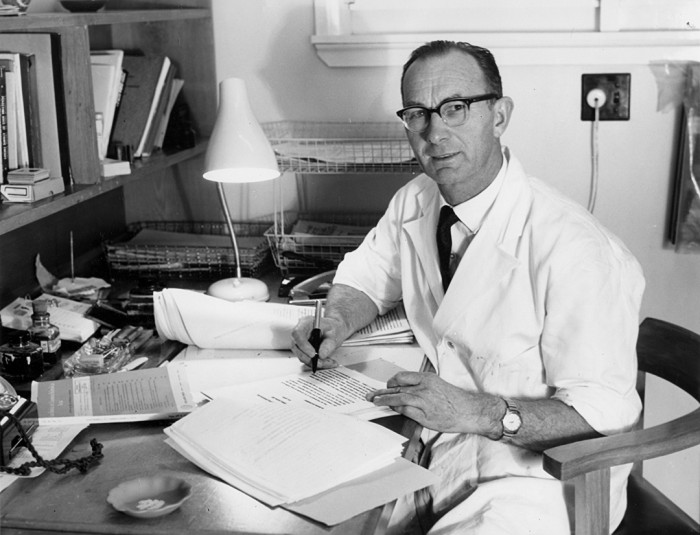
Athol Rafter in his office. In the days before computers and calculators, the radiocarbon age of a sample had to be calculated by hand from the measured values, a time consuming and very careful task for Rafter and his colleagues. Photo: Earth Sciences NZ.
Rafter and colleagues began measuring radiocarbon (14C) in 1951, with their initial measurements applied to the challenge of determining the age of the Taupō eruption. They continued to strive for higher quality and precision and soon developed an innovative carbon dioxide (CO2) gas counting system at their new laboratory in Lower Hutt near Wellington.
Rafter’s team detected two crucial signals in their radiocarbon in carbon dioxide (14CO2) measurements that would transform climate science. Firstly, they detected a decline in atmospheric (14C)caused by carbon dioxide from fossil fuel burning, providing evidence that human activities were impacting our atmosphere and climate, and at a pace faster than previously thought. The measurements also revealed a dramatic spike in 14CO2 linked to above-ground nuclear weapons testing in the 1950s and early 1960s, which produced huge amounts of radioactive particles before it was banned in 1963.
The radiocarbon measurements provided a way to track how carbon moves through the planet. The (14C) signal from the nuclear testing is used as a tracer to study ocean circulation, carbon exchange between atmosphere, land and oceans, soil processes, and fossil fuel CO2 emissions.
The measurements begun by Rafter at Makara, and now collected at Baring Head, form the world’s longest continuous record of atmospheric trace gas measurements, with more than 70 years of data and counting.
The Rafter Radiocarbon Laboratory continues to play a vital role in research programmes, carbon dating, and a wealth of other science applications.