
Out in all weathers
New Zealand's economy is founded on weather and climate-sensitive industries. This means understanding elements such as how wind behaves over varied and complex terrains, how much water is flowing in a river or how much rain has fallen is crucial to the country’s prosperity.
Hundreds of environmental information monitoring stations are spread across New Zealand and the Pacific; some on top of mountains, some in fields, some in rivers and oceans and others in urban areas..
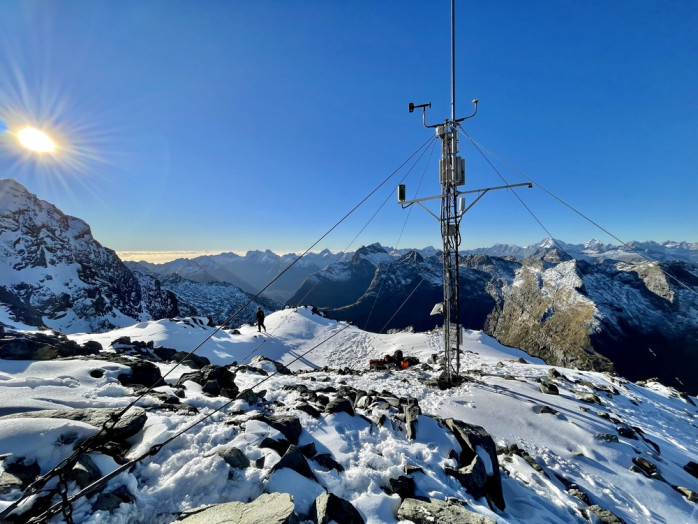
Hundreds of environmental information monitoring stations like this are spread across New Zealand and the Pacific. Photo: Earth Sciences NZ
These stations operate 24 hours a day and collect a vast range of data about New Zealand’s environment from the upper atmosphere to the seafloor providing critical information and insights.
One such dataset is the Seven Station Series which dates back to 1909. These climate and weather stations, in seven locations across the country, help us understand how our national average temperatures have changed over a long period of time.
Long-term datasets that track persistent change in the environment are a critical component of any modern ecosystem-based approach to natural resource management and sustainable growth. They are also essential for understanding New Zealand’s hydro-electricity reserves.
Data from our monitoring stations also contribute to global data sets enabling greater understanding of our changing climate.
Our data and those of regional councils are also used for weather and flood forecasting, drought and seasonal prediction, and for calibration of weather and hydrological models, and in the design of buildings, bridges, seawalls and stopbanks.