
The botanical backbone of a nation
In 1928, a young botanist named Harry Howard Barton Allan began assembling plant specimens in a modest house in Palmerston North. What began as a small, systematic endeavour soon became the Botany Division of the DSIR – and at its centre stood the Herbarium that would later bear Allan’s name.
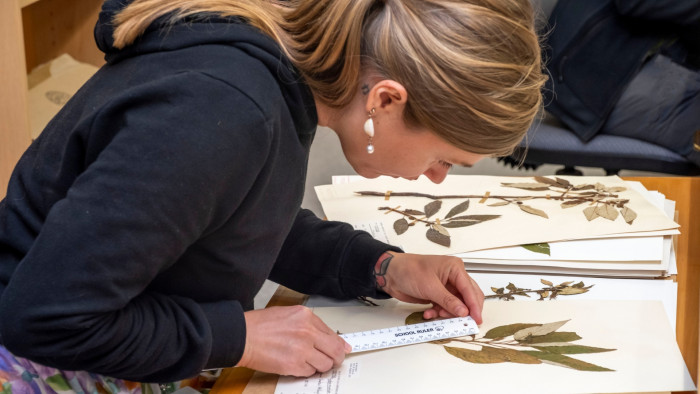
Scientist Jo Carpenter studying specimens in the Allan Herbarium
In its early decades, New Zealand’s landscapes were changing rapidly under farming, forestry, and settlement. Scientists identified weeds, studied pasture grasses, advised on noxious plants, and supported agriculture. During wartime, botanists investigated fibre plants, medicinal crops, and agar-producing seaweeds – research that contributed directly to national resilience.
For more than 60 years, every botanist and ecologist in New Zealand has relied on the Flora of New Zealand series (five volumes begun by Allan in 1961 and finally completed in 2000, plus lichens in 2007 and liverworts still being written). These are the definitive guide to identifying and naming our plants, and we are still writing e-flora online. All these Flora provide the taxonomic framework that underpins conservation, biosecurity, agriculture, and environmental policy In New Zealand.
During this time, the Allan Herbarium grew into a nationally significant collection, now with over 800,000 physical specimens. The Herbarium’s experts continue to support conservation listings, threatened species assessments, and rapid biosecurity responses to new plant incursions. The collection preserves evidence of vegetation now vanished, provides baseline data for climate change research, supports international research collaborations, and connects people with their cultural heritage.
This sits alongside the National Forestry Herbarium in Rotorua, established in 1945, which houses about 31,000 fully catalogued, geo-referenced and securely quarantined specimens of indigenous and exotic forest tree species.